Interfaith Thanksgiving Address
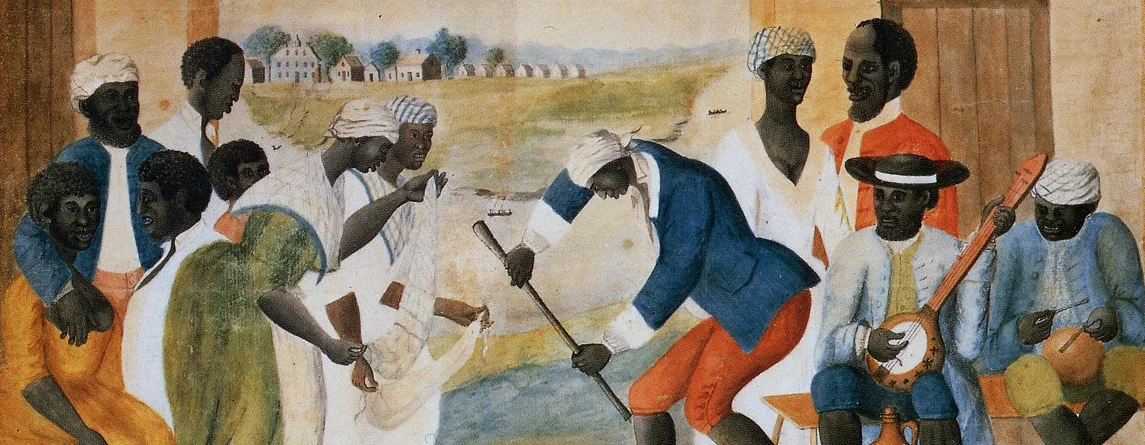
The Old Plantation (Slaves Dancing on a South Carolina Plantation), ca. 1785-1795. watercolor on paper, attributed to John Rose, Beaufort County, South Carolina. Abby Aldrich Rockefeller Folk Art Museum, Williamsburg, Virginia, USA.
Delivered at St. Joseph Catholic Church for Annual Interfaith Thanksgiving Service
Just over 48 ago, while sitting at a small café on a beach in Tel Aviv, a bustling metropolitan city in Israel, I simply observed the people around me - I watched friends catching up over coffee, students deep in thought laboring over their laptops – A couple with their dog simply relaxing with drinks over dinner. And as I settled into my stool at a counter overlooking the Mediterranean Sea I found myself content. Happy. And Free.
But it wasn’t the food in front of me that put a smile on my face, nor the warmth of drinking hot tea on a breezy shoreline. Or even the calming sound of the rolling waves brushing against the sand. It was something else. In a way, it wasn’t even that time or that specific place that I felt thankful for. But rather, I felt gratitude for the collective journey of my ancestors. The timeline of people, places, and events that allowed me to be that café soaking in the experience.
Because what I ultimately realized about that moment is that it wasn’t built entirely by me and me alone. Yes, I had picked that cafe. And yes, I had traveled to this ancient land. But I wasn’t the first to dig my toes into this sand. To walk along its shorelines. I hadn’t patched together stones to give my family shelter. I hadn’t plucked Israeli grapes or bundled sheaves of wheat. I hadn't sailed thousands of miles in damp barracks, huddled around the frail and young – crying babies and hungry, tired passengers as they made their way to a foreign land. A land only spoken of in ancient texts, prayers, and stories of old.
No, this blissful, serene moment was bestowed upon me by innumerable faces and names of those who came before me – soldiers, families, young men and women, grandfathers and mothers who believed in a dream dreamt by their ancestors.
Famous political zionists Theodor Herzl spoke the following words to his brethren in 1896, 52 years after the UN voted to grant a home to the Jewish people:
“Day is dawning. We need only rub the sleep out of our eyes, stretch our limbs, and convert dreams into reality. Let sovereignty be granted us over a portion of the globe large enough to satisfy the requirements of the nation - the rest we shall manage for ourselves. Neither fable nor fraud! Every man may test its truth for himself, for every man will carry with him a portion of the Promised Land — one in his head, another in his arms, and another in his acquired possessions. We shall live at last as free men, on our own soil, and die peacefully in our own home. [1] ”
And so, people of all nations journeyed back again to this once desolate landscape to create something new – Something they could call their own. Never knowing the extent of their labor; what their dream would one day create for the generations that followed. Not knowing that a young Jewish man from Macon, Georgia would have the pleasure or leisure to sit quietly in a café in a bustling metropolis by the seashore.
And what I learned in that moment is that gratitude isn’t something that arrives on our doorstep like the morning paper. Gratitude isn’t something we earn on our merit alone. While it is unequivocally important to acknowledge the gifts we have in our lives at the current moment and to be appreciative of the love and beauty that exists around us – Our family, friends, relatives, the food that sustains us – the community that uplifts us – we should also be grateful for the men and women that granted us the freedoms we have today here in the United States. The Native American’s who cultivated, protected, and honored the sacred mountains and valleys that we’ve come to call home. The wives of soldiers who embroidered uniforms and flags, ran shop during the day while looking after her five children. The framers of our constitution and the ideals of freedom they helped implant into the hearts and souls of our countrymen. The veterans who served in WWII to defeat a fascist regime fueled by hatred and dominance.
But also each one of you, who work tirelessly to give your families a treasure beyond wonder or words. Teaching them values, morals, and the precepts of your religion, helping them to build this word with love.
Today, on this evening, I am grateful for those who continue instilling in your children a passion for righteousness and kindness to others. I am thankful for your parents, grandparents, and their ancestors, who may have done the same. And hopefully, one day, years from now, generations after will come to recognize and appreciate the gifts they received from people like yourself. Because that is the story, the narrative of human life on earth. To build upon the efforts of those who once stood in the same pews, on the same day, singing the same prayers and who sought after the same goals of community, friendship, empathy, kindness, and faith.
In the Jewish tradition, there’s a famous parable concerning this notion:
One day, [Honi] was walking along the road when he saw a certain man planting a carob tree. Ḥoni said to him: This tree, after how many years will it bear fruit? The man said to him: It will not produce fruit until seventy years have passed. Ḥoni said to him: Is it obvious to you that you will live seventy years, that you expect to benefit from this tree? He said to him: That man himself found a world full of carob trees. Just as my ancestors planted for me, I too am planting for my descendants. [2]
And so, gathered around people of all faith traditions, I say "Thank You." I am grateful what you have done for our country and this city, what your ancestors provided for us today, and "Thank You" to the generations after who will continue our mission of prosperity and peace for all people of all ages, races, and creed. I am grateful for those who provided for me a Land to live as a free person, on American soil, in a place that I am proud to call home.
Amen.
[1] “A Jewish State: An Attempt at a Modern Solution of the Jewish Question,” Theodore Herzl
[2] Taanit 23a, The William Davidson Talmud