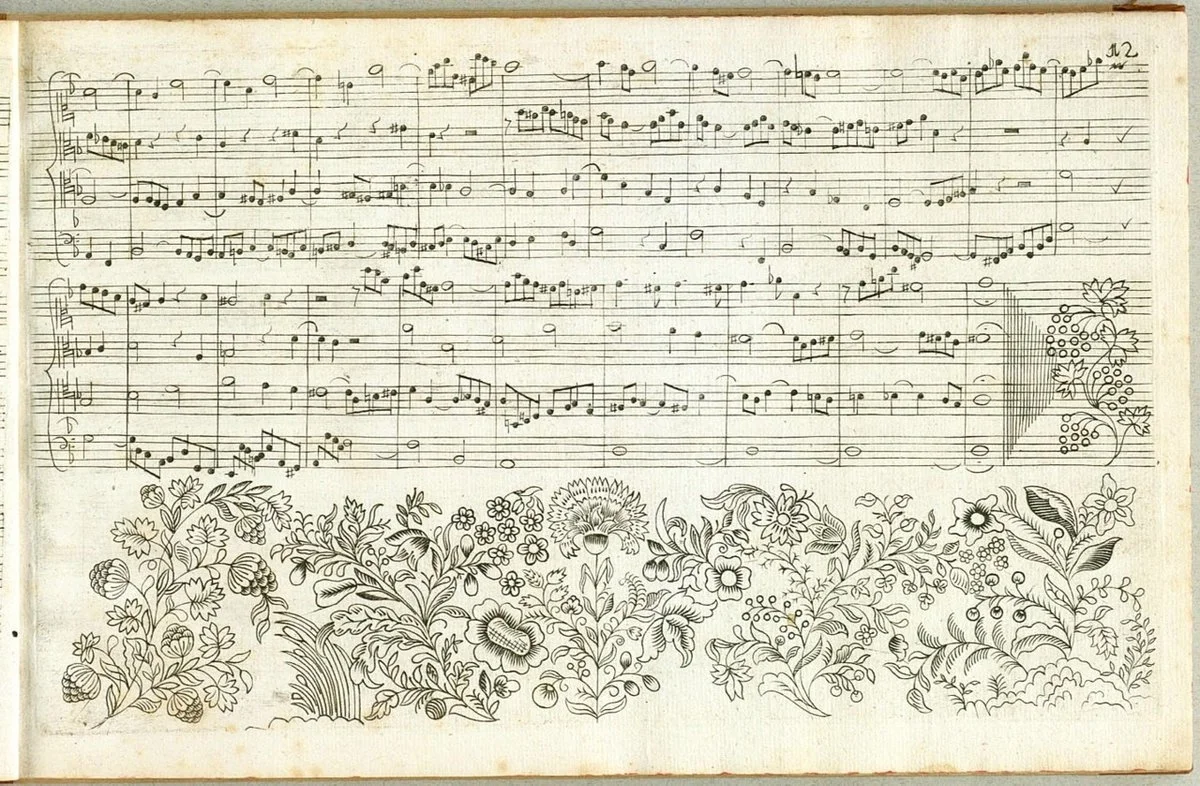
Johann Sebastian Bach’s Kunst Der Fuge. First Edition, Contrapunctus 1, Pg.12
We need open space to expand, to move, to breathe, and to move forward. Space can be physical or emotional. Space can be a separation or a vacation. Ultimately, space defines so much of our lives. Limited space might make us uncomfortable or more comfortable. Introverts need personal space to re-energize. Extroverts need to fill space with friends and excitement. The space we have or don't have defines us and shapes us. Composer Robert Fripp once wrote, "Silence is the field of creative musical intelligence, which dwells in the space between the notes, and holds them in place.” If the notes were played all at once, it would just be noise.”
When our children go off to college, space opens up in that relationship. But what happens in that space? We send our children out into the world to become independent, to think for themselves, to take care of themselves, and to become themselves. We need space to grow, and to be heard like a note in a song.In Parshat Beshalach, we see a people struggling with a lack of space. We see the Israelites struggling within the enclosure of Egypt. The narrowness of a land in which they are slaves. God tells Moses to lead the Israelites out of Egypt because “They are astray in the land; the wilderness has closed in on them.”
“The Israelites were suffocating from a lack of space - they were dying, crying out in despair. But God literally opens a space for the Israelites to escape. “Then Moses held out his arm over the sea and the LORD drove back the sea with a strong east wind all that night, and turned the sea into dry ground.And the Israelites went into the sea on dry ground, the waters forming a wall for them on their right and on their left.” [1]
God leads the people out of Egypt through this opening that God formed, leading us "out of Egypt." In Hebrew, the word Egypt is mitzriyim (מִּצְרָֽיִם). Mi (מִּ), meaning "from," and tzriyim (צְרָֽיִם), meaning "narrows." Egypt literally means “from the narrows.” God devises an opening for escape when he opens the Red Sea. It was this open space that God granted our people that allowed us to be the people we are today. God sends the Israelites into the wilderness, to form their covenant, to make laws, to become independent, to develop, themselves as nations. Because when we give ourselves open space, we are also allowing room for new creations.
The real question is: what does it mean to have open space? What makes space so crucial in defining who we are as individuals and as a nation?
“The creation of the world came about in essence by way of open space, without which all would have been endless divinity, and there would have be no place for the creation of the world. Therefore, God withdrew light to the margins, and the open space was formed, and in that space, God created the world, through acts of speech. And so it is, too, with disagreement – For if all the sages were of one mind there would be no place for the creation of the world. It is only by way of disagreement between them, and their dividing from another, each one drawing to a particular side, that open space comes into being between them – which in its nature, is like the withdrawing of primordial divine light to the margins – in the midst of which creation can take place.”
What we can learn from this, is that open space allows for the creation of something new. Open space allows for differentiation and uniqueness. Open space provides room for discovery. Open space affords us a place to challenge established thoughts, to have new ideas, and to become something different. Open space creates an opportunity for something new to come into existence. So let us widen our perspective. Let us not imprison our minds as the Israelites were enslaved in Egypt. Let’s open our minds like God opened the Red Sea for the Israelites. Let us create an original thought and not smother it, but instead give it space to flourish. If we make these openings for creation, we can discover something new about ourselves or our world. So emancipate your thoughts from the bonds of others who tell you how to think and who to be. Let us not become slaves to the narrowness of thought, but let us make an exodus from mitzriyim, an exodus from the narrows. Because who knows what we will find, who we might become, or what we might discover.
[1] Exodus 14:3; 21-22